

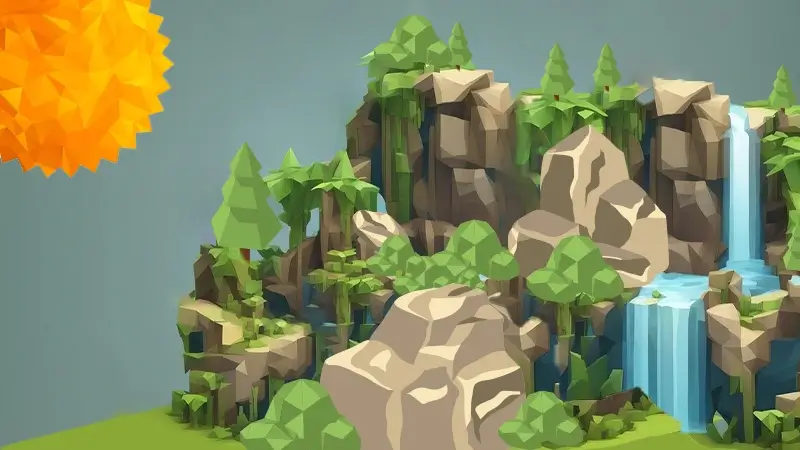
Types of 3D art 3D art consists of the different technologies that need to fuse to bring an animated conversion of a scene or object into real life. The key representation of types of 3D art is as follows: 3D Modeling 3D modeling uses special software to create a three-dimensional representation of a physical object or scenery. Models can be constructed from scratch using polygon modeling, spline modeling, or sculpting. There are different kinds of 3D models: Hard Surface Modeling: Rigged up and mechanical objects build (e.g. cars, weapons, buildings). Organic Modeling: A modeling technique for soft, life-like shapes (such as the human form, animal shape, and plant form). Low-poly Modeling: Models created with fewer polygons are usually used for performance-hungry games or mobile apps. High-poly Modeling: This technique creates very finely detailed models for applications such as film or 3D printing. Texturing Texturing is giving a 3D model color, material attributes, and reality by specifying surface details added to the models. Textures can simulate wood, metal, stone, or skin. Texture mapping is done through UV mapping, in which the model's surface is unwrapped into a 2-D space for easier painting or image mapping. Major types of textures include: Diffuse/Color Map: Base color texture.Normal Map: Add depth and detail to the surface without increasing polygons. Specular Map: Controls shininess and reflectivity on a surface. Bump Map: Simulates texture and surface detail but does not affect model geometry. Displacement Map: Changes the model's geometry to give real depth or height.Roughness Map: Determines surface smoothness or roughness for shading. Lighting and Shading Lighting and shading are very important in representing a scene in 3D that lacks depth, mood, and realism. They characterize the model as it interacts with light, leading to a very different look. Lighting refers to all the light sources in a scene, such as where they are placed and what types they are. Types of lights comprise: Point Light: Emits light from a single point in all directions. Directional Light: Mimics sunlight, casting light in a specific direction. Spotlight: Casts light in a cone shape, like a theater spotlight. Ambient Light: Soft, even light that fills the scene. Area Light: A light source with a specific area, average sources producing soft shadows. Shading is the interaction of surfaces with light and how the materials look under different lighting conditions; nowadays, shaders simulating skin, metallic, glass, or cloth items control these. Phong Shading: A simple shading model meant to produce smooth, shiny surfaces. Blinn-Phong Shading: A variant of Phong shading that is more suitable for simulating certain kinds of reflections. PBR (Physically-Based Rendering): A more advanced shading model that attempts to simulate the behavior of light on surfaces in the real world for better realism. Rendering Rendering Finalization implements all the various 3-dimensional models, textures, light, and shade into a flat two-dimensional image or animation. There are everal methods and engines for rendering. Rasterization: Fast rendering technique exclusively used for real-time applications such as games. It ultimately produces an image through polygons, generating 3D models into two-dimensional images. Ray-tracing: Ray-tracing performs more intensive computations while simulating how light behaves in an environment of objects. Thus, it produces high-quality reflections, refractions, and shadows.

Have an idea, a project requirement, or need expert guidance for your digital journey? Our team at Innovatix Technologies is here to help you with tailored solutions, quick support, and seamless communication. Get in touch with us today and let’s turn your vision into reality.

Ready to start a project?
Cyber City, 1207, near Silver Trade
VIP Circle To Utran Road, Uttran, Surat
technologiesinnovatix@gmail.com
Sales: (+91) 99250 49821